
Best Joint Supplement for Dogs? Read This Before Choosing

The best joint supplement for a dog is not automatically the jar with the longest ingredient list or the loudest promise. It is one with a transparent label, ingredients that fit your dog's needs, a realistic serving size, and a plan you can follow consistently.
A label checklist at a glance
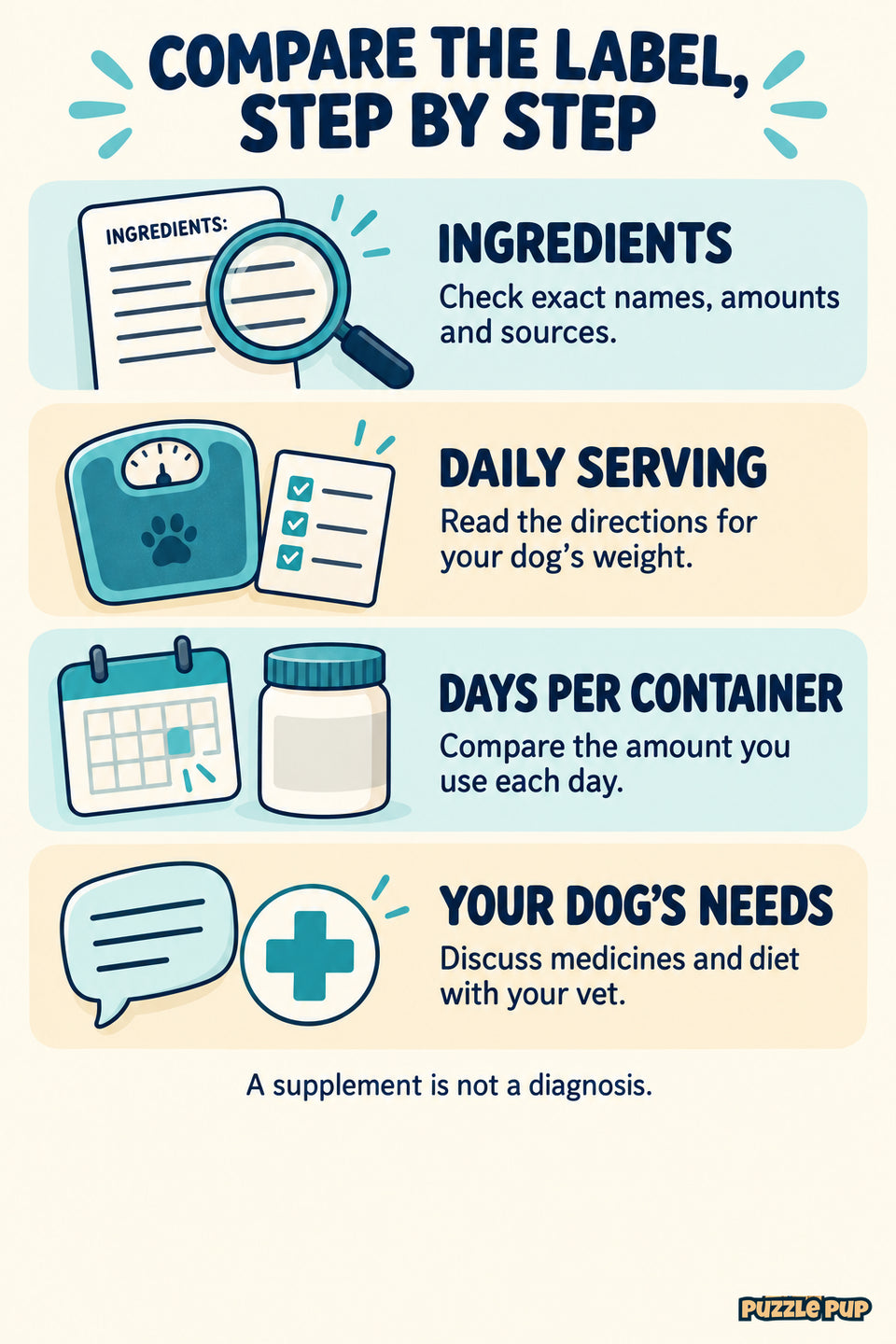
The short answer
Compare the amount per daily serving, not just the ingredient names on the front. Look for clear daily directions for your dog’s weight, named active ingredients, quality documentation, and a manufacturer that tells you what is actually in the chew. Then confirm the choice with your veterinarian when your dog has pain, takes medication, or has an existing condition.
How to compare joint supplements for dogs
1. Read the active-ingredient panel
Do not stop at a front-label phrase such as “advanced mobility.” Turn the jar around. A useful label identifies each active ingredient and the amount supplied per stated serving. That lets you compare products on more than marketing language.
2. Calculate the real daily serving
A 60-chew jar is not always a 60-day supply. Larger dogs may need more than one chew per day. Compare the number of chews your dog needs at their weight, the number of days the jar lasts, and the cost per day.
3. Match the formula to the job
Mobility formulas often combine ingredients because they play different nutritional roles. More ingredients are not automatically better; the formula should be understandable and appropriate for your dog.
4. Check the cautions and inactive ingredients
Review flavoring, allergens, animal-derived ingredients, and label cautions—especially if your dog has food sensitivities. Follow storage and serving instructions, and keep the product away from children and other pets.
5. Look for accessible quality information
A serious supplement company should be able to provide a current label and answer basic questions about manufacturing or lot documentation. A certificate of analysis can verify identity and quality checks for a specific batch, but it does not prove that a supplement will produce a particular result in every dog.
6. Ignore miracle timelines
Joint supplements work through daily use; they are not instant pain medicine. Be skeptical of promises that every dog will run, climb stairs, or stop limping within a fixed number of days.
7. Make sure your dog will actually take it
The most carefully selected chew cannot help if it stays in the jar. Taste, texture, serving frequency, and digestive tolerance matter because consistency matters.
Common mobility ingredients
Glucosamine
Glucosamine appears in different forms and can come from different sources. Compare the named form and amount per serving rather than assuming every product is equivalent.
Chondroitin
Chondroitin is often paired with glucosamine. Check the source, amount, and full formula, particularly when your dog has dietary sensitivities.
MSM
Methylsulfonylmethane, usually shortened to MSM, is a sulfur-containing compound included in many joint formulas. Its presence alone does not establish a product outcome.
Boswellia, turmeric, and other botanicals
Some formulas add botanical ingredients for a multi-ingredient formula. Their presence does not replace clear dosing, veterinary guidance, or appropriate care for pain and injury.
Which dogs may benefit from a mobility plan?
- Senior dogs whose daily movement is changing
- Active, working, or athletic dogs with demanding activity schedules
- Large-breed dogs and dogs carrying extra body weight
- Dogs whose veterinarian recommends a nutritional assessment
A supplement is not a substitute for an exam. Limping, sudden weakness, swelling, crying out, difficulty standing, or a rapid change in movement should be evaluated by a veterinarian.
Talk with your veterinarian first when
Your dog takes prescription medication, has a bleeding disorder, diabetes, kidney or liver disease, is pregnant or intended for breeding, is preparing for surgery, or has persistent pain or mobility changes. Bring the complete product label so your veterinary team can review the full formula.
How PuzzlePup Hip & Joint compares
PuzzlePup Hip & Joint Soft Chews list glucosamine HCl, MSM, chondroitin, Boswellia, and other actives with amounts and daily directions for your dog’s weight. Each jar contains approximately 60 chews; the full label shows ingredients and cautions.
We do not call one product universally “best.” The right starting point depends on your dog's size, current schedule, health history, label preferences, and veterinary guidance.
Questions dog parents ask
When should a dog start taking a joint supplement?
There is no single age for every dog. Breed, size, activity level, body condition, injury history, and veterinary recommendations all matter. Ask during a regular wellness visit if you are considering proactive nutrition.
Can a dog take more than one joint product?
Do not stack products without comparing their complete labels. Overlapping ingredients can increase the total daily amount and may increase side effects or interactions.
How long should I try a joint supplement?
Follow the label and your veterinarian's guidance. Keep brief notes about appetite, stool, willingness to move, walks, stairs, and play so you can judge the plan more objectively.
What matters more: jar price or daily cost?
Daily cost is the more useful comparison. Divide the jar price by the number of days it lasts at your dog's weight, then consider label clarity, product quality, and how easily your dog takes it.